USDT TRC-20 vs ERC-20 vs BEP-20: What’s the Difference?
USDT TRC-20, ERC-20 and BEP-20 are the same dollar on different blockchains. How they differ in fees, speed, address format and liquidity, which network to choose, and how not to mix them up.
3 min readTronOrb team
On this page
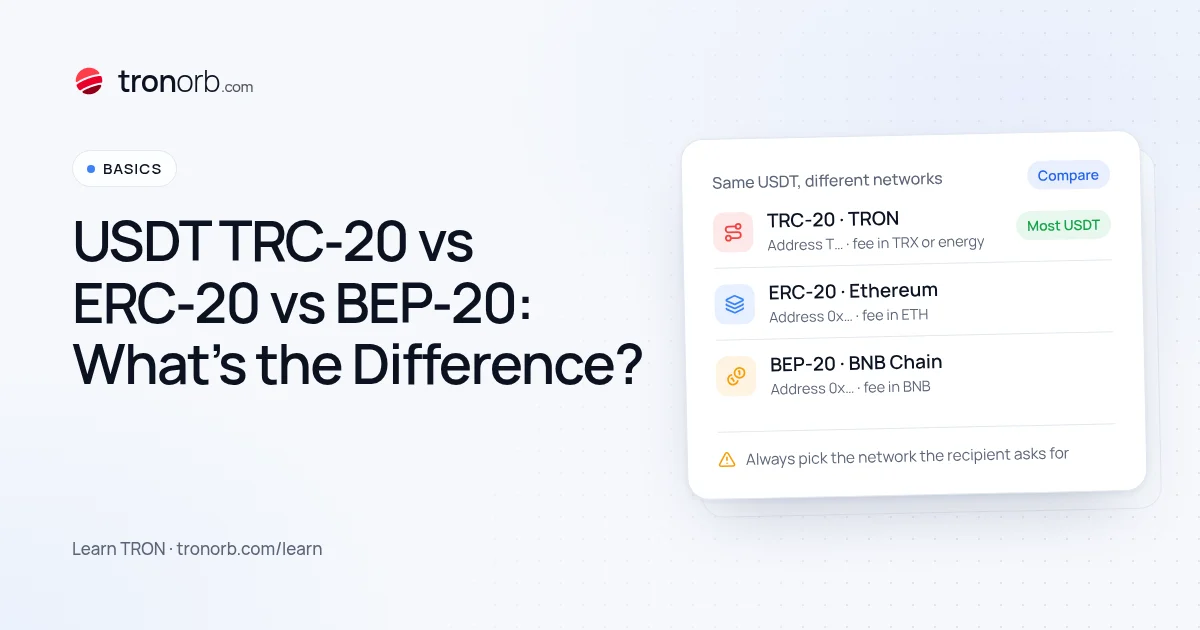
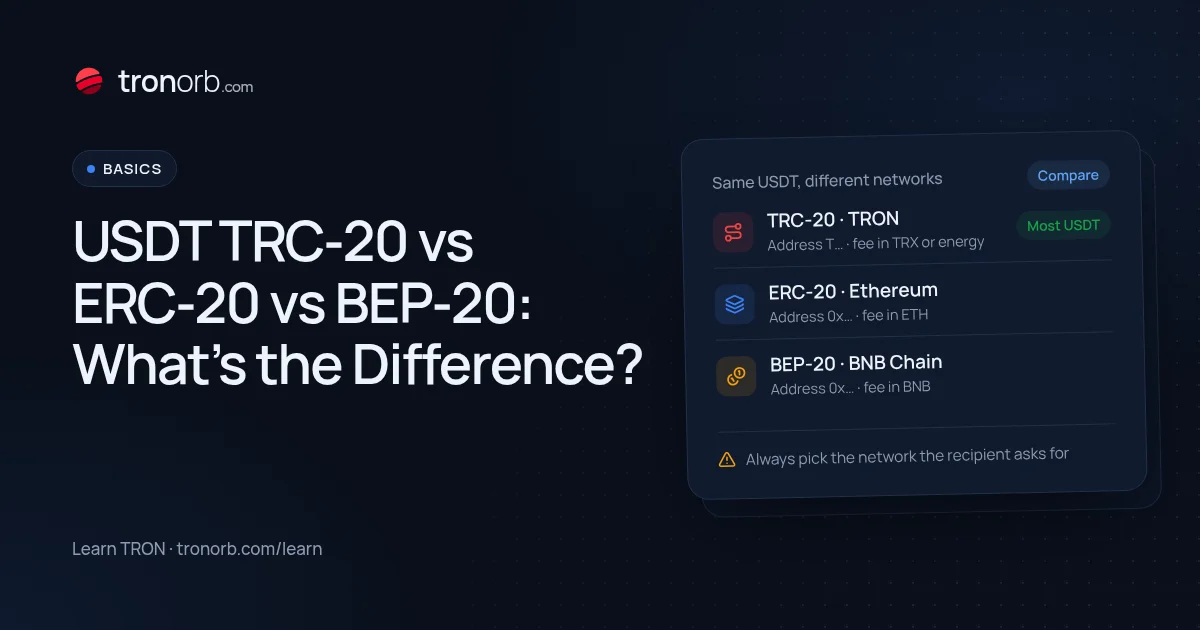
"Send me USDT — TRC-20 or ERC-20?" If you've seen that question and weren't sure, you're not alone. TRC-20, ERC-20 and BEP-20 are the same Tether dollar issued on different blockchains: TRON, Ethereum and BNB Chain. The value is identical — 1 USDT ≈ $1 on each — but fees, speed, addresses and where you can use them differ. This guide explains the differences and how to pick the right one.
Same USDT, different networks
Tether issues USDT separately on several blockchains. Each version is a token on that chain, following that chain's token standard:
- TRC-20 — the token standard on TRON.
- ERC-20 — the token standard on Ethereum.
- BEP-20 — the token standard on BNB Chain (formerly Binance Smart Chain).
They're not interchangeable on-chain. USDT on TRON can't be sent to Ethereum directly, and vice versa — moving between networks takes an exchange or a bridge.
Side-by-side comparison
| TRC-20 (TRON) | ERC-20 (Ethereum) | BEP-20 (BNB Chain) | |
|---|---|---|---|
| Address format | Starts with T, 34 characters | 0x…, 42 characters | 0x…, 42 characters |
| Fee paid in | TRX or energy | ETH | BNB |
| Block time | ~3 s | ~12 s | ~3 s or less |
| USDT supply | The largest of any network | Large | Smaller |
| Typical use | Payments, exchanges, P2P | DeFi, institutions | Binance ecosystem, low-cost transfers |
Live supply and fees for each network are on USDT networks compared. At the time of writing, TRON holds more USDT than any other network — about half of the USDT on the major chains we track.
Fees: which is cheapest?
It depends on how you pay:
- TRC-20 without energy costs several TRX per transfer (about twice that to an address with no USDT) — see USDT fee today. That's more than most other networks right now.
- TRC-20 with rented or staked energy drops to a fraction of that — which is how exchanges and payment services send USDT on TRON cheaply. See how to get TRON energy.
- ERC-20 follows Ethereum gas prices, which swing a lot: at quiet times a transfer costs cents or less, during busy periods it can cost dollars.
- BEP-20 is usually cheap, paid in BNB.
Fees move with gas and coin prices, so check the live comparison before large or frequent transfers.
Why TRC-20 is so popular
- Liquidity and acceptance. Most exchanges, OTC desks and P2P traders support TRC-20, and many default to it.
- Speed. Blocks every ~3 seconds; a transfer is final in about a minute (confirmations).
- Predictable costs for businesses that stake or rent energy.
Which network should you choose?
- The one the recipient asks for. This matters more than fees. An exchange deposit address for TRC-20 only accepts TRC-20.
- Sending to a T… address → TRC-20.
- Sending to a 0x… address → ERC-20 or BEP-20 (or another EVM network) — ask which one; the address format is the same.
- Your own wallet: pick the network where you'll use the USDT, and keep the native coin (TRX, ETH or BNB) for fees.
How not to mix them up
- On an exchange withdrawal page, select the network that matches the recipient's address and request.
- If the recipient gives you a 0x address, never choose TRC-20 — and vice versa.
- For a new recipient, send a small test first.
- If it already happened, see sent USDT to the wrong network.
Quick answers
Is TRC-20 USDT real Tether? Yes — issued by Tether on TRON. The official contract is TR7NHqjeKQxGTCi8q8ZY4pL8otSzgjLj6t.
Can I convert TRC-20 to ERC-20? Yes, via an exchange (deposit TRC-20, withdraw ERC-20) or a bridge. It's a separate operation with its own fees.
Is one safer than the other? All three are issued by Tether and can be frozen by Tether. Security depends mostly on your wallet and habits.
Why does my exchange show different fees for each network? Each network has different costs; the exchange adds its own margin. Compare withdrawal fees.
Related
More in Learn
- How to Convert TRX to USDT (and Back)Three ways to swap TRX to USDT TRC-20 — on an exchange, with a wallet’s built-in swap or a TRON DEX, or through an instant exchange service — what each costs, how slippage and energy work, and what to check before you swap.Read
- How to Get TRON Energy: 4 Ways ComparedFour ways to get TRON energy for USDT transfers — burn TRX, rent energy, stake TRX or have it delegated — with costs, trade-offs and which one fits how often you send.Read
- What Is TRON Energy Rental and How Does It Work?TRON energy rental explained: how providers delegate energy to your address with Stake 2.0, what you choose when you order, how to stay safe, and when renting beats staking or burning TRX.Read
- How to Stake TRX for Energy (Stake 2.0), Step by StepStake TRX for daily energy so USDT transfers stop burning TRX: how much TRX you need, step-by-step staking in TronLink and other wallets, energy or bandwidth, voting with it, delegating, and what to know before unstaking.Read