How to Convert TRX to USDT (and Back)
Three ways to swap TRX to USDT TRC-20 — on an exchange, with a wallet’s built-in swap or a TRON DEX, or through an instant exchange service — what each costs, how slippage and energy work, and what to check before you swap.
3 min readTronOrb team
On this page
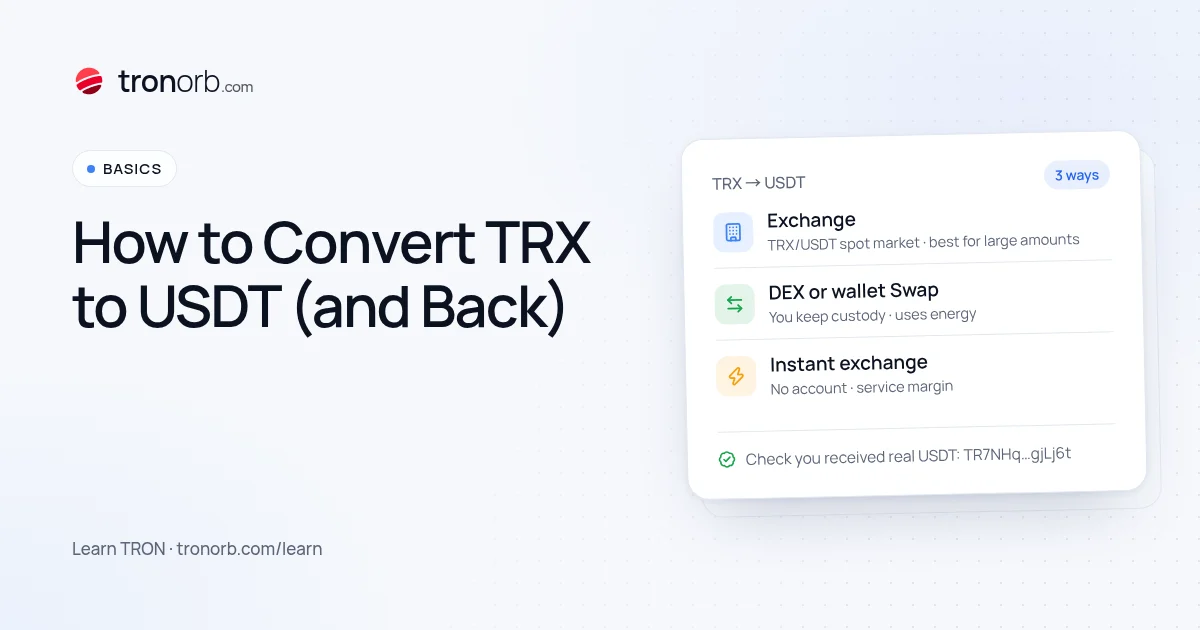
Swapping TRX to USDT is one of the most common things people do on TRON: to lock in a price, to pay someone in dollars, or to move funds out of TRX. There are three ways to do it, and they differ mostly in fees, speed and how much control you keep. This guide compares them and walks through each.
Three ways to swap
| Way | Where | You need | Good for |
|---|---|---|---|
| Exchange | Spot TRX/USDT market on a centralized exchange | An account (usually with KYC) | Large amounts, best rates |
| DEX / wallet swap | A TRON DEX such as SunSwap, or a wallet's built-in Swap | A TRON wallet with TRX | Keeping custody, quick swaps |
| Instant exchange service | A swap service that sends USDT to your address | Just your wallet | No account, simple one-off swaps |
Check today's rate before you swap: TRX to USDT.
Option 1: on an exchange
- Deposit TRX to the exchange (or buy it there).
- Open the TRX/USDT spot market and sell TRX — a market order fills instantly, a limit order at your price.
- Withdraw USDT to your wallet on the TRC-20 network — compare withdrawal fees.
Pros: deep liquidity, low trading fees, good for large amounts. Cons: you hand over custody while funds are on the exchange; deposits and withdrawals take time and fees.
Option 2: a DEX or your wallet's Swap
On TRON, swaps between TRX and USDT run through decentralized exchanges such as SunSwap. Many wallets have a built-in Swap button that routes through these DEXs.
- Open Swap in your wallet (or the DEX site, checked carefully for the right URL).
- Choose TRX → USDT and enter the amount.
- Check the quote: the rate, the price impact and the slippage tolerance.
- Confirm. The USDT arrives in the same wallet within seconds.
Costs to know:
- Swap fee charged by the pool (a small percentage).
- Energy: a swap is a smart-contract call and usually needs more energy than a USDT transfer. Without energy, TRX is burned — keep some TRX beyond what you're swapping, or rent energy.
- Slippage: the price can move between quote and execution; the tolerance caps how much.
Pros: you keep custody; no account; fast. Cons: you pay network energy; bad slippage settings can cost money on large swaps.
Option 3: an instant exchange service
Instant exchange services take your TRX and send USDT TRC-20 to an address you choose, usually without an account. Our exchanger directory lists services we've checked.
Pros: no account, simple. Cons: rates include the service's margin; check the service's terms and official site before sending.
Swapping USDT back to TRX
The same three ways work in reverse. One extra tip: if you need TRX only for fees, swap a little USDT to TRX — or use a GasFree wallet or energy rental instead. See send USDT without TRX.
What to check before you swap
- Real USDT. After a DEX swap, the received token must be
TR7NHqjeKQxGTCi8q8ZY4pL8otSzgjLj6t— scam pools can pay out fake tokens. Verify the contract. - Official sites only. Fake DEX and wallet sites ask you to approve tokens or enter your phrase.
- Approvals. Swapping USDT → TRX on a DEX asks you to approve USDT. Review and revoke old approvals with our token approvals tool.
- Enough TRX for energy. A failed swap still burns the energy it used.
Quick answers
What's the cheapest way to convert TRX to USDT? For large amounts, usually an exchange. For small amounts you already hold in a wallet, a DEX swap avoids deposit and withdrawal fees.
How long does a swap take? A DEX swap settles in seconds. Exchange swaps are instant, but deposits and withdrawals add minutes.
Why did my swap fail? Usually slippage (the price moved more than allowed) or not enough energy/TRX — see why a TRON transaction failed.
Related
More in Learn
- USDT TRC-20 vs ERC-20 vs BEP-20: What’s the Difference?USDT TRC-20, ERC-20 and BEP-20 are the same dollar on different blockchains. How they differ in fees, speed, address format and liquidity, which network to choose, and how not to mix them up.Read
- How to Get TRON Energy: 4 Ways ComparedFour ways to get TRON energy for USDT transfers — burn TRX, rent energy, stake TRX or have it delegated — with costs, trade-offs and which one fits how often you send.Read
- What Is TRON Energy Rental and How Does It Work?TRON energy rental explained: how providers delegate energy to your address with Stake 2.0, what you choose when you order, how to stay safe, and when renting beats staking or burning TRX.Read
- How to Stake TRX for Energy (Stake 2.0), Step by StepStake TRX for daily energy so USDT transfers stop burning TRX: how much TRX you need, step-by-step staking in TronLink and other wallets, energy or bandwidth, voting with it, delegating, and what to know before unstaking.Read