How to Send USDT (TRC-20) Without TRX
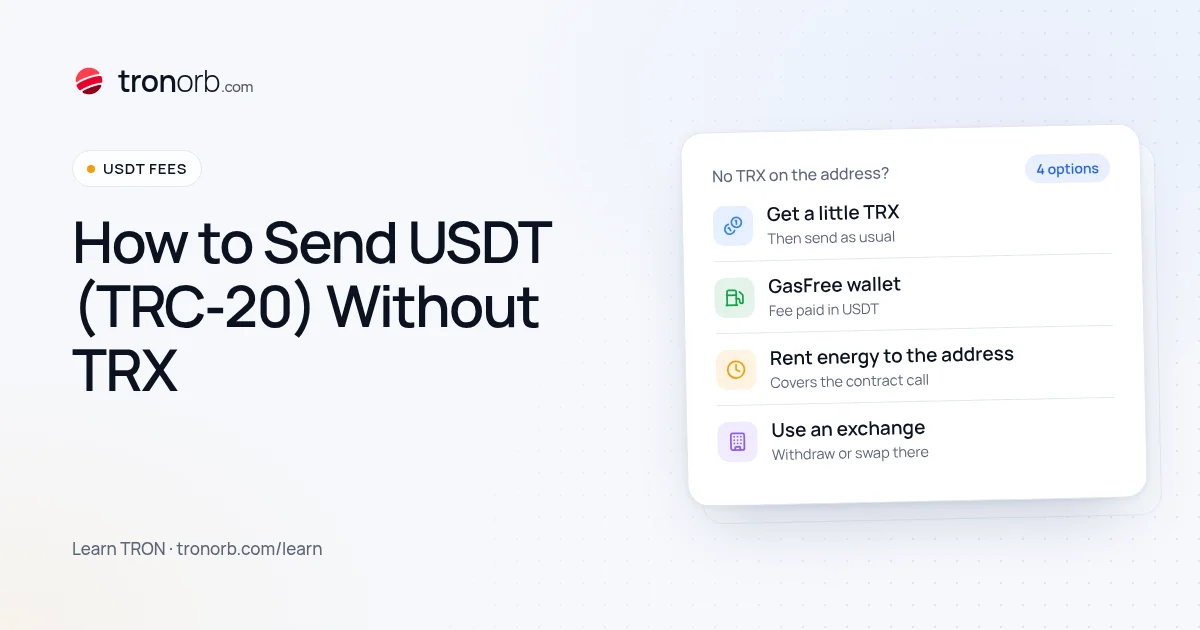
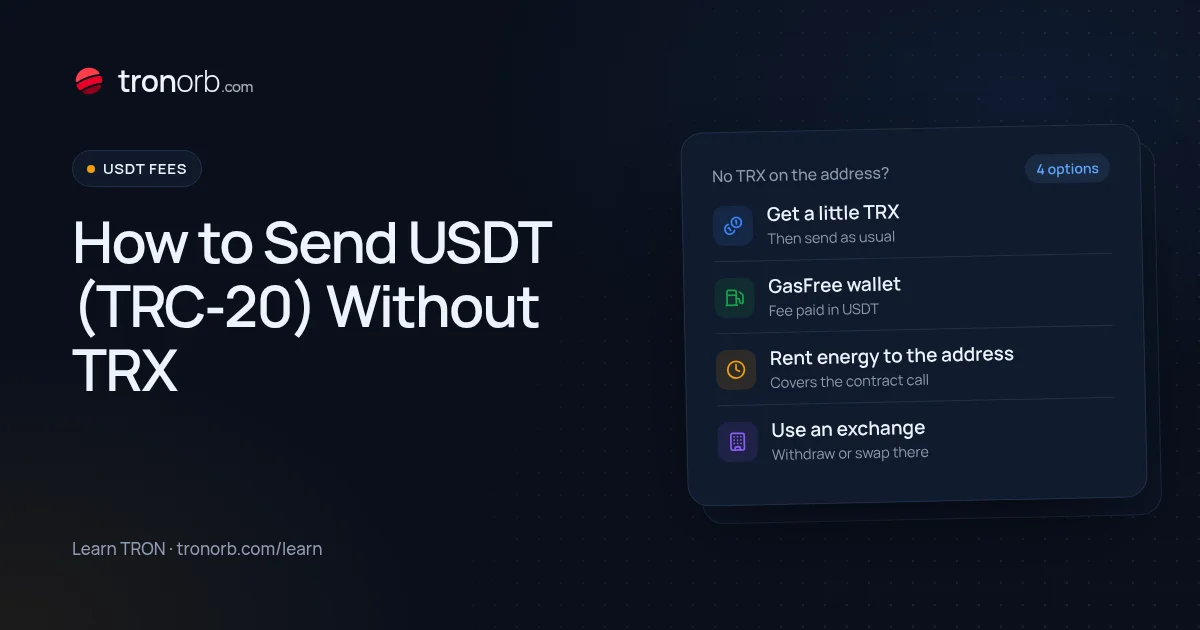
USDT on your TRON address but no TRX? Why you can’t send it, and four ways out — get a little TRX, use a GasFree wallet, rent energy, or withdraw from an exchange — with what each costs and what to avoid.
Updated 3 min readTronOrb team
On this page
You have USDT on a TRON address but no TRX, and the wallet won't let you send — or warns about insufficient resources. That's expected: every USDT transfer needs energy and bandwidth, normally paid in TRX. This guide explains why, then walks through the four ways out, from the simplest to the cheapest.
Why you can't send with zero TRX
USDT is a TRC-20 token. Moving it runs the USDT smart contract, which consumes:
- Energy — about 65,000 units to an address that already holds USDT, about 130,000 to one that doesn't;
- Bandwidth — about 345 bytes.
Without TRX to burn, or energy on the account, the transaction can't be paid for. Free daily bandwidth (600 per activated account) helps with bandwidth, but there's no free energy.
If the address has never received TRX, it may not even be activated — receiving USDT alone doesn't create a TRON account. See how to activate a TRON address.
Option 1: get a little TRX
The simplest fix, and usually the cheapest for a one-off transfer.
- Withdraw a few TRX from an exchange to the address, or ask someone to send some.
- Check how much you need in the USDT fee calculator: sending to an address that has never held USDT costs about twice as much.
- Send your USDT as usual.
Keep a small TRX buffer afterwards so you don't get stuck again.
Option 2: use a GasFree wallet
GasFree lets you send USDT without holding TRX: a service pays the network fee and takes its fee in USDT from your balance. Some TRON wallets have it built in.
- Pros: works with zero TRX; no extra steps.
- Cons: the service fee is usually higher than renting energy; check the fee in your wallet before confirming.
Good for: occasional transfers from an address with no TRX at all. More: what is GasFree.
Option 3: rent energy to the address
Energy rental services can delegate energy to your address so the transfer's energy is already covered.
- You pay the provider — usually in TRX, from another wallet, or through a Telegram bot.
- Rent enough for your recipient: about 65,000 energy, or about 130,000 if they've never held USDT.
- Bandwidth still has to come from somewhere: your free daily bandwidth usually covers it if the address is activated.
Compare providers in our energy rental directory. How rental works: TRON energy rental explained.
Option 4: withdraw from an exchange instead
If the USDT is (or can be) on an exchange, withdrawing directly to the destination avoids the problem entirely. The exchange pays the network fee and charges its own withdrawal fee.
Which option to choose
| Your situation | Best option |
|---|---|
| You have an exchange account | Withdraw a few TRX to the address, or withdraw USDT directly |
| Zero TRX and no exchange | GasFree wallet |
| You send regularly from this address | Get TRX, then rent or stake for energy |
| Address not activated yet | Get TRX first — it activates the address |
What not to do
- Don't pay "unlock" or "activation" fees to strangers. No legitimate service needs your recovery phrase or a payment to "release" your USDT.
- Don't import your recovery phrase into an unknown app that promises free transfers.
- Don't send TRX to an address someone else gave you a phrase for — that's the multisig scam.
- Check the recipient with our USDT blacklist check before sending — a frozen recipient can't move USDT it receives.
Quick answers
How much TRX do I need? Roughly 7 TRX to an address that holds USDT, about 13 TRX to a new one, at today's prices — see USDT fee today.
Can I pay the fee in USDT? Only through GasFree-type services. The network itself charges in TRX or energy.
Why does my wallet say "insufficient bandwidth"? The address used up its free bandwidth, or isn't activated. See not enough bandwidth.
Related
More in Learn
- How to Convert TRX to USDT (and Back)Three ways to swap TRX to USDT TRC-20 — on an exchange, with a wallet’s built-in swap or a TRON DEX, or through an instant exchange service — what each costs, how slippage and energy work, and what to check before you swap.Read
- USDT TRC-20 vs ERC-20 vs BEP-20: What’s the Difference?USDT TRC-20, ERC-20 and BEP-20 are the same dollar on different blockchains. How they differ in fees, speed, address format and liquidity, which network to choose, and how not to mix them up.Read
- How to Get TRON Energy: 4 Ways ComparedFour ways to get TRON energy for USDT transfers — burn TRX, rent energy, stake TRX or have it delegated — with costs, trade-offs and which one fits how often you send.Read
- What Is TRON Energy Rental and How Does It Work?TRON energy rental explained: how providers delegate energy to your address with Stake 2.0, what you choose when you order, how to stay safe, and when renting beats staking or burning TRX.Read