USDT TRC-20 Fee Explained: Why It’s 7 or 13 TRX and How to Pay Less
Why a USDT transfer on TRON costs about 7 TRX — or 13 TRX to a new address — what you actually pay for, and four ways to pay far less: rent energy, stake TRX, GasFree, or plan transfers.
Updated 4 min readTronOrb team
On this page
"Why did sending USDT cost me 13 TRX?" is one of the most common questions about TRON. The short answer: the fee depends on who you send to and on whether you pay with energy or by burning TRX. This guide walks through the math, the reasons the number changes, and how to bring it down to a fraction.
What you actually pay for
TRON has no single "gas" fee. A USDT (TRC-20) transfer uses two separate resources:
- Energy — for running the USDT smart contract. This is the big part of the fee.
- Bandwidth — for the transaction's size in the block, about 345 bytes for a USDT transfer.
Every account gets a small amount of free bandwidth each day (600 points), which covers a couple of simple transactions. Energy has no free daily allowance: you either have it on your account (from staking or rental) or the network burns TRX to cover it.
The burn rate is the energy price — a chain parameter set by Super Representative votes, measured in SUN (1 TRX = 1,000,000 SUN). Check today's energy price and the live fee on USDT fee today.
Why 7 TRX one day and 13 TRX the next
| Recipient | Energy | Burn cost at 100 SUN per energy |
|---|---|---|
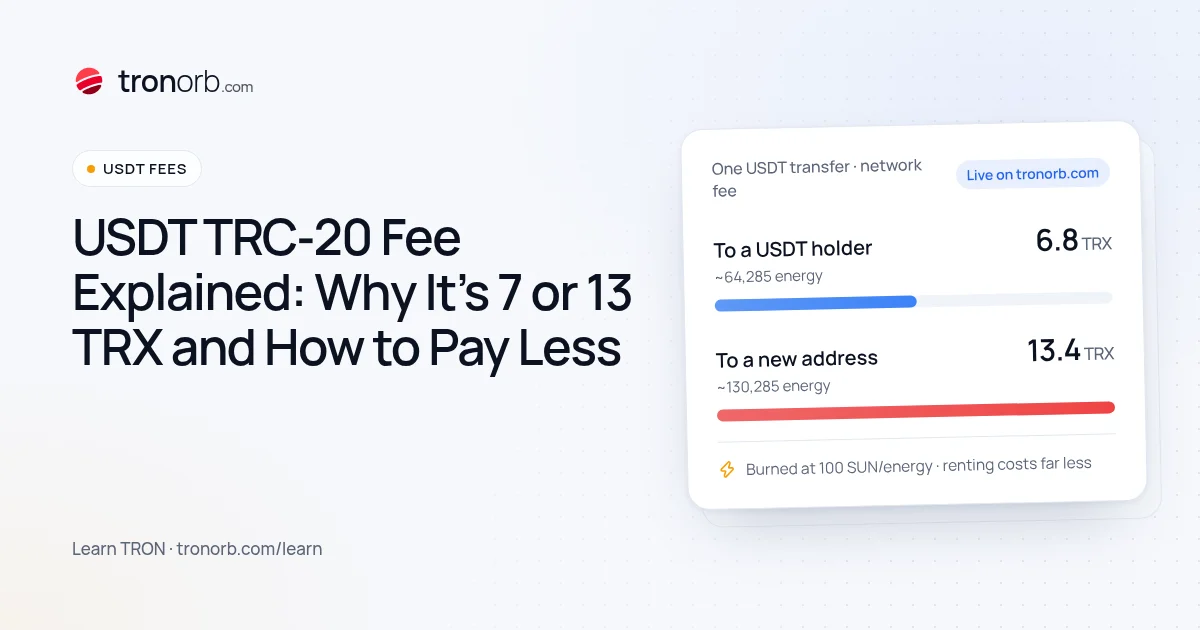
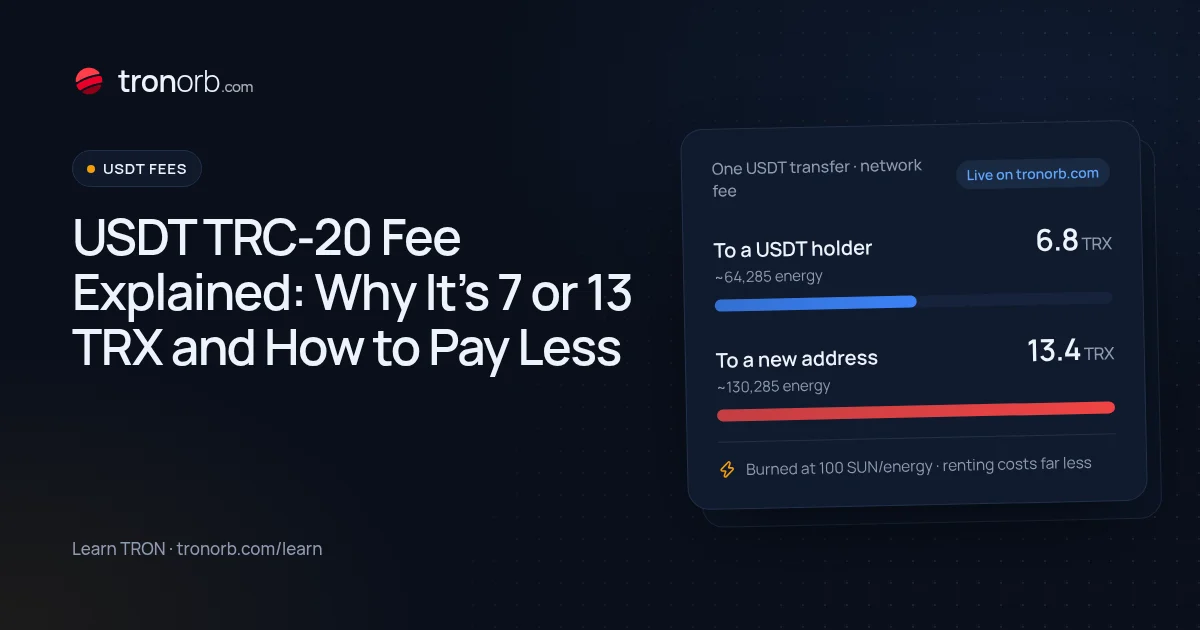
| Already holds USDT | ~64,285 | ~6.4 TRX + bandwidth ≈ 6.8 TRX |
| Has never held USDT | ~130,285 | ~13.0 TRX + bandwidth ≈ 13.4 TRX |
Sending to an address that has never held USDT needs about twice the energy, because the USDT contract has to create a new balance entry in its storage. That's the "13 TRX" case — common when you pay a fresh exchange deposit address, a new wallet, or an address that emptied its USDT long ago and was cleaned up.
Bandwidth adds about 0.35 TRX only when your free daily bandwidth is already used up.
Why the fee changes without you doing anything
Three things move the number you see:
- The recipient. Holder vs. new address, as above — the single biggest factor.
- The energy price. It's a network parameter. When Super Representatives change it, every USDT transfer becomes cheaper or more expensive overnight.
- The TRX price. The fee is burned in TRX, so its dollar value moves with the market even when the TRX amount stays the same.
The amount of USDT does not matter. Sending 10 USDT or 100,000 USDT costs the same energy.
Four ways to pay less
1. Rent energy
An energy rental service delegates energy to your address for a set time — from a few minutes to days. You pay the provider instead of burning TRX, usually a fraction of the burn cost. No lock-up, nothing to manage afterwards. Best for occasional or irregular transfers. How it works: what is TRON energy rental.
2. Stake TRX (Stake 2.0)
Stake TRX for energy and you get a share of the network's energy every day, refilled over 24 hours. Nothing is burned, and the TRX stays yours — but unstaking takes 14 days, and you need a fairly large stake to cover one USDT transfer a day. Check the numbers in the energy calculator and the steps in how to stake TRX for energy.
3. Use a GasFree wallet
GasFree-style wallets pay the network fee for you and charge it in USDT. Handy when you hold no TRX at all, though the convenience costs more than renting. See how to send USDT without TRX.
4. Plan your transfers
- Send fewer, larger transfers instead of many small ones — the fee is per transfer, not per dollar.
- Prefer recipient addresses that already hold USDT when you have a choice (for example, an exchange deposit address you've used before).
- Avoid sending "test" transfers to a brand-new address: the first one costs the most.
Compare all four for your own volume in the USDT fee calculator.
What happens if you don't have enough
If your account has neither enough energy nor enough TRX to burn, the transfer fails with OUT_OF_ENERGY — and the TRX already consumed by the failed attempt is not returned. Make sure you have either rented energy or enough TRX before sending. More: OUT_OF_ENERGY on TRON.
Why exchanges charge a different fee
Exchange withdrawal fees are set by each exchange, not by TRON. They cover the network cost plus the exchange's own margin and often stay the same for months, even when the network fee drops. Compare them on USDT TRC-20 withdrawal fees by exchange.
Quick answers
Is the USDT fee paid in USDT? No — in TRX (or with energy). The USDT amount you send arrives in full. Only GasFree-type wallets deduct a fee in USDT.
Can I see the fee before sending? Most wallets show an estimate. Our USDT fee today page shows both cases — to a holder and to a new address — at the current energy price.
Is TRON still cheaper than Ethereum for USDT? Usually, yes — see USDT network comparison.
Related
More in Learn
- How to Convert TRX to USDT (and Back)Three ways to swap TRX to USDT TRC-20 — on an exchange, with a wallet’s built-in swap or a TRON DEX, or through an instant exchange service — what each costs, how slippage and energy work, and what to check before you swap.Read
- USDT TRC-20 vs ERC-20 vs BEP-20: What’s the Difference?USDT TRC-20, ERC-20 and BEP-20 are the same dollar on different blockchains. How they differ in fees, speed, address format and liquidity, which network to choose, and how not to mix them up.Read
- How to Get TRON Energy: 4 Ways ComparedFour ways to get TRON energy for USDT transfers — burn TRX, rent energy, stake TRX or have it delegated — with costs, trade-offs and which one fits how often you send.Read
- What Is TRON Energy Rental and How Does It Work?TRON energy rental explained: how providers delegate energy to your address with Stake 2.0, what you choose when you order, how to stay safe, and when renting beats staking or burning TRX.Read