Sent USDT to the Wrong Network? How to Recover It
Sent USDT on the wrong network — TRC-20 instead of ERC-20, BEP-20 instead of ERC-20? How to find where it went and the four recovery cases: your wallet, an exchange, someone else, or an address nobody controls.
Updated 3 min readTronOrb team
On this page
- 1Why "wrong network" happens
- 2First: check where the USDT actually is
- 3Case 1: you sent to your own wallet on the wrong network
- 4Case 2: you sent to an exchange deposit address on the wrong network
- 5Case 3: you sent to someone else's wallet
- 6Case 4: the address can't exist on that network
- 7Watch out for "recovery" scams
- 8How to avoid it next time
- 9Quick answers
You sent USDT and picked the wrong network — TRC-20 instead of ERC-20, BEP-20 instead of ERC-20, or similar — and it never arrived. Whether you can get it back depends on where it went and who controls that address. In many cases the money isn't lost, just sitting on a chain nobody is watching. Here's how to work out your case.
Why "wrong network" happens
USDT exists on many blockchains: TRON (TRC-20), Ethereum (ERC-20), BNB Chain (BEP-20), and others. They're separate networks. A transfer on one is invisible on the others. When you withdraw from an exchange, you choose the network — and if it doesn't match what the recipient expects, the coins land on a different chain.
Address formats help:
- TRON addresses start with T and have 34 characters.
- Ethereum, BNB Chain, Polygon, Arbitrum and other EVM networks use the same 0x… format.
That's why most real-world mix-ups happen between EVM networks — for example, sending USDT on BNB Chain to an Ethereum address. TRON ↔ Ethereum mix-ups are rarer, because a T… address isn't valid on Ethereum and most exchanges refuse it.
First: check where the USDT actually is
Take the transaction ID from your wallet or exchange and look it up on the explorer of the network you actually used: TRONSCAN for TRON, Etherscan for Ethereum, BscScan for BNB Chain, and so on. If the status is success, the USDT is sitting at the destination address on that network.
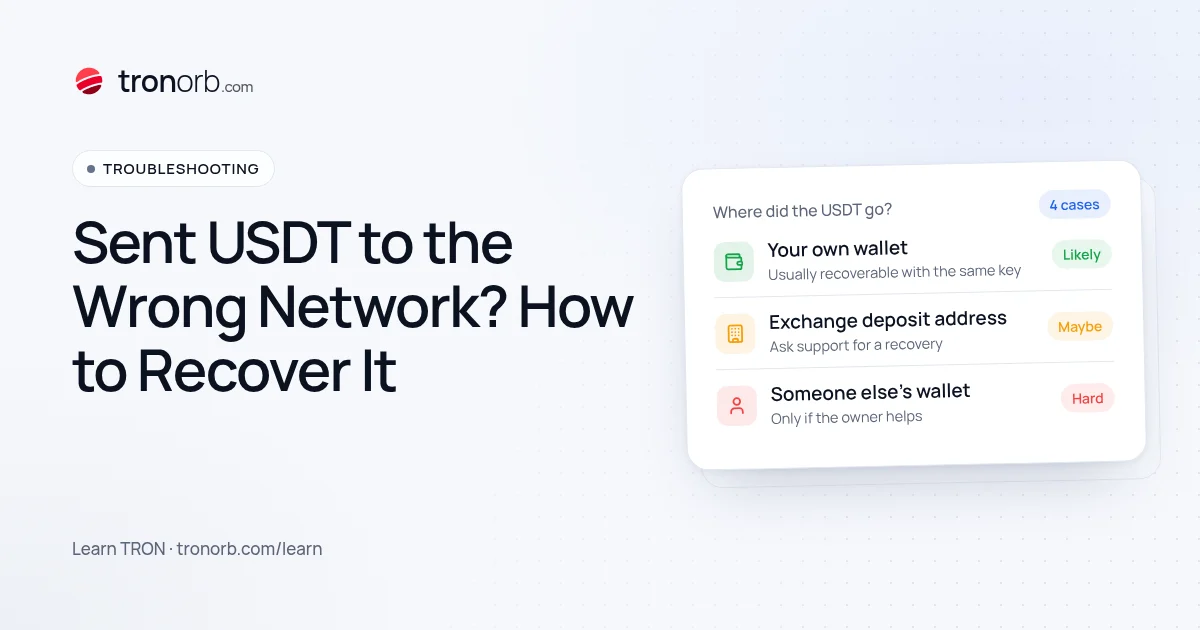
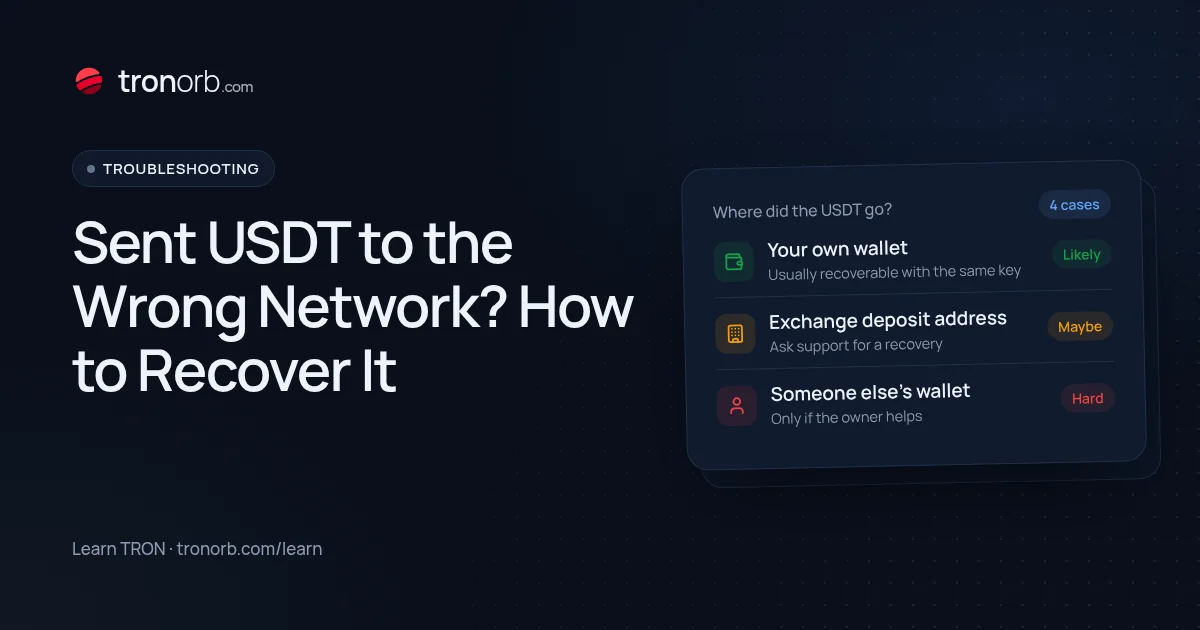
Case 1: you sent to your own wallet on the wrong network
Often recoverable.
- Between EVM networks (Ethereum, BNB Chain, Polygon…): the same 0x address exists on all of them and is controlled by the same key. Add the network you used to your wallet (or import the wallet into one that supports it), and the USDT will be there.
- TRON and an EVM network: wallets generate TRON addresses differently from Ethereum ones, so your T… and 0x… addresses are different. If the funds went to your address on the network you used, open the same recovery phrase in a multi-chain wallet that supports that network.
You'll need the native coin of that network (TRX, ETH, BNB…) to pay the fee to move it back.
Case 2: you sent to an exchange deposit address on the wrong network
The exchange controls that address, not you. Many exchanges can recover wrong-network deposits — often for a fee, and not always. Contact support with:
- the transaction ID,
- the network you used and the one you should have used,
- your account ID and the deposit address.
Some exchanges have a self-service "deposit recovery" form. Expect it to take days or weeks.
Case 3: you sent to someone else's wallet
Only the owner of that address can move the funds. If it's their own multi-chain wallet, they can usually recover it as in Case 1 and send it back. If it's an exchange address, see Case 2 — the owner has to contact their exchange.
Case 4: the address can't exist on that network
Most wallets and exchanges refuse to send to an address in the wrong format. If a transfer did go through to an address nobody controls — for example, a contract address or a mistyped one — the funds can't be recovered.
Watch out for "recovery" scams
People who lost funds are targeted by fake "recovery services" in comments and DMs. Nobody can move coins from an address without its key or the exchange that controls it. Don't pay upfront fees or share your recovery phrase.
How to avoid it next time
- On exchanges, the withdrawal network must match the receiving address: address starting with T → choose TRC-20 (TRON).
- Copy the deposit address and the network from the receiving side, not from memory.
- Send a small test amount first to any new address.
- Compare USDT networks and exchange withdrawal fees in advance — a cheaper network tempts people to switch, which is when mistakes happen.
Quick answers
Is my USDT lost? Usually not if it went to your own wallet or an exchange. It's lost only if nobody controls the destination address.
Can TRONSCAN or Tether reverse it? No. Neither the explorer nor Tether reverses transfers sent to the wrong network.
How long does exchange recovery take? It varies by exchange — from days to weeks.
Related
More in Learn
- How to Convert TRX to USDT (and Back)Three ways to swap TRX to USDT TRC-20 — on an exchange, with a wallet’s built-in swap or a TRON DEX, or through an instant exchange service — what each costs, how slippage and energy work, and what to check before you swap.Read
- USDT TRC-20 vs ERC-20 vs BEP-20: What’s the Difference?USDT TRC-20, ERC-20 and BEP-20 are the same dollar on different blockchains. How they differ in fees, speed, address format and liquidity, which network to choose, and how not to mix them up.Read
- How to Get TRON Energy: 4 Ways ComparedFour ways to get TRON energy for USDT transfers — burn TRX, rent energy, stake TRX or have it delegated — with costs, trade-offs and which one fits how often you send.Read
- What Is TRON Energy Rental and How Does It Work?TRON energy rental explained: how providers delegate energy to your address with Stake 2.0, what you choose when you order, how to stay safe, and when renting beats staking or burning TRX.Read