Stake vs Rent TRON Energy: Which Is Cheaper?
Stake TRX for daily energy or rent it per transfer? How each works, what it really costs (including the cost of locked TRX), a worked example, and which is cheaper for occasional vs daily USDT transfers.
Updated 3 min readTronOrb team
On this page
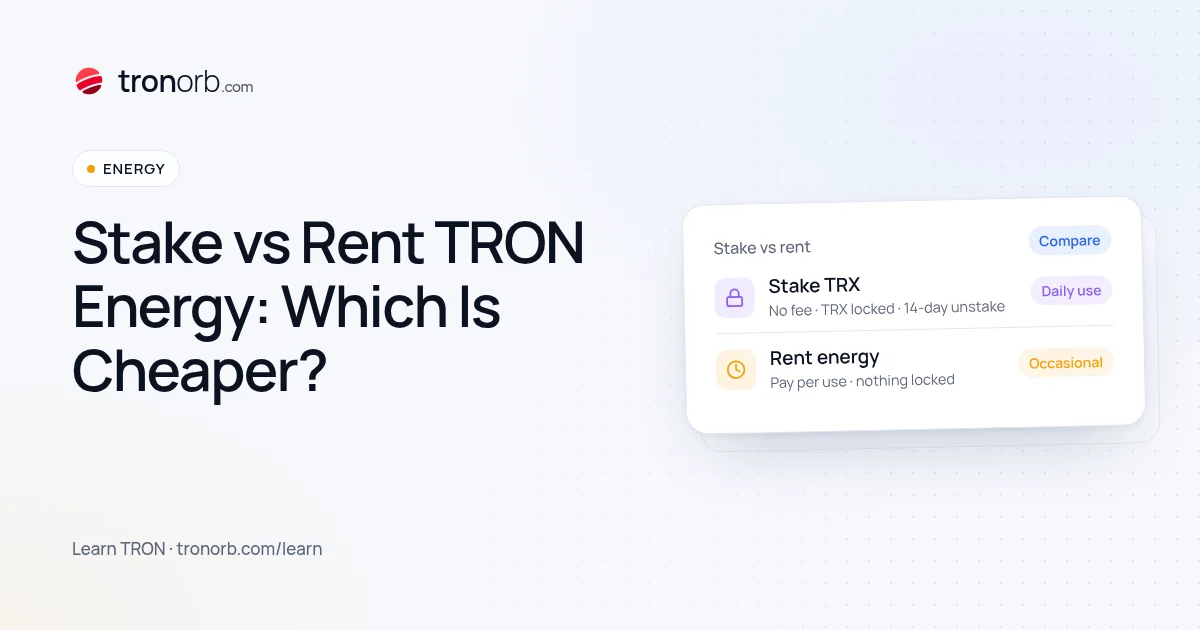
There are two ways to stop burning TRX on every USDT transfer: stake TRX for energy or rent energy from a provider. Which one is cheaper depends mostly on how many transfers you make, whether you already hold TRX, and how long you plan to keep doing it. This guide gives you the comparison and a simple way to decide.
The short version
| Stake TRX (Stake 2.0) | Rent energy | |
|---|---|---|
| Upfront | Lock TRX (you keep it) | Pay per rental |
| Ongoing cost | None burned | Every time you need energy |
| Flexibility | Unstaking takes 14 days | Rent only when you send |
| Price risk | TRX price moves your capital | None beyond the rental fee |
| Best for | Regular daily transfers, TRX you'd hold anyway | Occasional or irregular transfers |
| Bonus | Vote for an SR and earn voting rewards | — |
How staking works
When you stake TRX for energy, you receive a share of the network's daily energy proportional to your stake. That energy refills every day, so the same stake pays for transfers day after day. Your TRX stays in your account; to get it back you unstake and wait 14 days.
How much do you need? It depends on the live network rate — see the energy calculator, which converts staked TRX into daily energy and tells you how much TRX covers one USDT transfer a day. It's typically thousands of TRX per daily transfer, so staking pays off mainly if you already hold TRX or send every day.
The hidden cost of staking
Staked TRX isn't spent, but it isn't free either:
- it's locked — you can't sell it quickly if the price drops;
- if you bought TRX only to stake, you carry its price risk;
- you could have earned something else with that capital.
Voting rewards from Super Representatives offset part of this.
How renting works
An energy rental service delegates energy to your address for a period (from minutes to days). You pay the provider, typically much less than burning the same energy. Nothing is locked, and you rent only when you need to send. Compare providers in our energy rental directory, and see how energy rental works.
A simple way to decide
- Count your USDT transfers per day (on average).
- Check in the energy calculator how much TRX covers that many transfers a day.
- Ask yourself: do I already hold that much TRX, and will I keep it for months?
- Yes → stake. It costs nothing extra.
- No → rent. Buying TRX just to stake ties up capital and adds price risk.
Which is cheaper for you?
- A few transfers a month: rent energy (or just burn TRX if the amounts are small).
- Several transfers a week: rent.
- Several transfers a day, and you hold TRX anyway: stake — it costs nothing extra.
- Several transfers a day, no spare TRX: rent, or buy TRX and stake if you'll keep doing it for months.
- No TRX at all: use a GasFree wallet — see send USDT without TRX.
Plug your own numbers into the USDT fee calculator — it compares burning, renting, staking and GasFree side by side.
Can you combine them?
Yes. Many businesses stake enough TRX for their typical daily volume and rent extra energy on busy days. Staked energy is used first; rental covers the peaks.
Quick answers
Is staking risk-free? Your TRX stays yours, but its price moves and it's locked for 14 days after unstaking.
Do I lose energy if I don't use it? Staked energy refills up to a maximum; unused capacity isn't stored. Rented energy is gone when the rental ends.
Can I stake and rent out my energy? You can delegate staked energy to other addresses; some services pool energy from stakers.
Related
More in Learn
- How to Convert TRX to USDT (and Back)Three ways to swap TRX to USDT TRC-20 — on an exchange, with a wallet’s built-in swap or a TRON DEX, or through an instant exchange service — what each costs, how slippage and energy work, and what to check before you swap.Read
- USDT TRC-20 vs ERC-20 vs BEP-20: What’s the Difference?USDT TRC-20, ERC-20 and BEP-20 are the same dollar on different blockchains. How they differ in fees, speed, address format and liquidity, which network to choose, and how not to mix them up.Read
- How to Get TRON Energy: 4 Ways ComparedFour ways to get TRON energy for USDT transfers — burn TRX, rent energy, stake TRX or have it delegated — with costs, trade-offs and which one fits how often you send.Read
- What Is TRON Energy Rental and How Does It Work?TRON energy rental explained: how providers delegate energy to your address with Stake 2.0, what you choose when you order, how to stay safe, and when renting beats staking or burning TRX.Read